
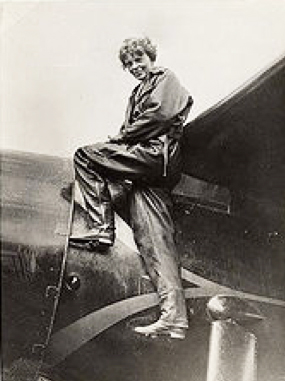
I first got to know Amelia (so to speak) when I read a devoted follower of hers years ago. He's one of many around the world, who continue to investigate the mysterious disappearance of her plane 75 years ago, during an attempted flight around the world. Here (below) is my account of the session that I included in Beyond Boundaries, the Adventures of a Seer.
It details a fascinating journey-beyond-time that I took when I merged with the timeless (streaming) consciousness of the famed aviatrix.
Theories continue to surface, especially when certain artifacts are discovered. The most recent one involves an old jar that had contained anti-freckle cream!
From Beyond Boundaries, The Adventures of a Seer
CHAPTER 15: FAMOUS ENTITIES
Amelia
I looked out of the small plane as it veered to the right, tilting towards a clearer view of the northern coast of Africa. We were flying so low that I was able to enjoy the contrast of the solid green density of coastline trees with the blue-green sparkle of the Atlantic Ocean. I was aware of a small out-of-the-way supply station used for refueling, housed in an old wooden shack.
Then I knew that there were kites. They were being let out from the plane. "What's with all these kites!" I asked. I found myself in a timeless space that happened to be right in the center of Amelia Earhart's consciousness. I found myself there because I was in the middle of a reading.
I was reading Dick Freeman, whose wife Jane had given him a reading for his birthday. She had warned me, "Watch out. He has this special interest!" And so, once we began his reading, he started to ask about a passion in his life, his interest in the life and disappearance of Amelia Earhart. An aeronautical engineer, he had researched information about her for years and had met her when he was a young boy.
Even before Dick could ask about Amelia, she projected herself into our session. But instead of relaying specific messages, she allowed me to enter—or I simply merged—with her consciousness. I was experiencing, in a timeless space, her last flight around the world.
"Now we're in the water, the right side of "our" body hurts." I continued, "And there are round things floating in the water—they look like ping-pong balls!"
"Yes!" Dick again confirmed, "She had them in the plane for flotation!"
"And there's someone behind us, at the back of the plane - a man who is monitoring things. He's saying something, but we can barely hear him talk."
"That would be Fred Noonan, her navigator," Dick interjected.
"We're going down now! It feels like it's happening in slow motion, and not from as great a height as I'm accustomed to flying," I added quickly, trying to give Dick a responsible play-by-play account.
We went on and on like that for what seemed like hours, until we got tangled up in Dick's enthusiasm to have me put all that I was viewing and experiencing in reverse (on instant replay!), to try to fit my descriptions of the islands as we approached them quickly from the air (we were crashing!) to the maps he now held on his lap.
Months later, Dick asked me to do a special reading for him. He hoped that I could go back to re-experiencing Amelia's flight and give more details about her life and what had become of her. The following information is taken from Dick's transcription of the tape from that reading, nearly seventy pages of notes.
Admittedly, at times Dick's enthusiastic responses to what I viewed and experienced through Amelia's consciousness may have been somewhat leading, as he was excited to have much of what I witnessed fit his theories about the disappearance of Amelia. But most of the information came so much in its own context and form— often "out of left field"—I feel that it can be trusted.
Knowing that Dick would want to pursue further explorations about Amelia after his first reading, I purposely avoided researching her or any other aviators. The most reliable and satisfying readings I do are those that come about when I come in "cold," with few connections to the subject or persons involved. Otherwise, interpreting and relaying the information given in the reading can become very confusing, foggy, and frustrating. I am able to disengage enough and come in from a different angle with friends whom I read as clients, but for projects such as this, I make a special effort to not influence myself.
My one connection to the world of aviation had been my father, who was an aeronautical engineer at Lockheed Aircraft. He used to tell bizarre tales about meeting and running into Howard Hughes, but that is the extent of my background information concerning the world of aviation, at least that I'm consciously aware of. I even wonder if that slight influence of my father's occupation might have played some part in my path intersecting with Dick's.
Reflecting Back On Her Life
I settled in again with Dick and, very soon, with Amelia. I flowed easily back into her consciousness. She began by emphasizing the thoughts, over and over, that there was a far greater purpose in her mission than in all the intrigue and missing details regarding her last flight.
She projected information about a soul group who had reunited in this incarnation, all of varied chronological ages. They had combined energies toward a greater purpose before, in other life spaces. She said that many in the group were very intuitive, and that there is a wonderful combination of talents that have often combined to create novel inventions.
I watched one shared life experience that had been a cumbersome, much less refined one, filled with hardships. The group developed a way to transport heavy goods (I saw cannons) from one place to another on rugged platforms—some sort of cart or buckboard with wheels. It looked as though the wheels had been carved by hand. There were many battles, wars, and the desire for greater ease in life.
Again, she added, their mission this time went beyond the abilities of their good technological minds. It had to do with gaining a greater understanding about life. She hoped that our session would demonstrate that thoughts, emotions, memories, and curiosities go far beyond the death of the physical body.
She showed me another time, when they had been fascinated by how things moved, and had visions of heavy objects flying through the sky. There seemed to be a soulful agreement to come together in a time when that would be technologically possible. And they certainly had done so.
Amelia continued, saying that some included in the soul group were those like Dick, who was obsessed with uncovering the details about her life, and others were those who touched her life in seemingly minimal ways. Then she showed me a scene of her meeting Dick when he was eight years old, in a large building.
Dick confirmed that he was overjoyed at meeting her when his father had taken him to the Purdue University Armory Building. Amelia was a professor at Purdue, providing real-world leadership to the young women in the school. This meeting was just prior to her world flight, and the faculty of Purdue was invited to hear her plans for the trip.
She projected scenes of herself as young as three and four years old, trying to make something—it looked like a little rolling cart—work. She said that she came in that way—with curiosities, visions and ambitions—and again said that it wasn't the first time, and, if my interpretation was correct, she added that it wouldn't be the last. Dick later verified that Amelia and her sister had built a wooden box roller coaster which they launched from their garage roof in Atichison, Kansas.
Personal Background
Amelia presented her life to me like a landscape, pointing out peaks of experiences that rose above others. Many of these were events which helped her not take life too seriously, that made her laugh. Those moments stood out to her because they seemed to be in such contrast to her customary intensity. She often emphasized that those were the times that pulled her out into life, not the events that everyone was so eager to know about.
She went into some detail about the intensity with which she had lived her life. She said that part of it pulled her to accomplish much, and part of it went inward and caused much confusion about her identity. At one point she mentioned wearing men's clothing and dressing like her friend, Charles A. Lindbergh.
She projected memories of sitting at the feet of a father or grandfather, whom she envied, because he was a man, and the conflict she felt about all that her mother tried to teach her about being a female. She said that her younger sister, Muriel, always understood her conflict. Although Amelia felt some unfinished business with her sister (and something left unsaid, about a boy lost or drowned in a river), she acknowledged that Muriel had been an example of one who easily accepted the proscribed roles available to a female, later settling in to a domestic role with a husband and children.
She shared her awareness that she could now see that she had accomplished many things in other life spaces where she had incarnated into male bodies. She'd been quite frustrated at the limitations of living a life in female form and never quite resolved others' expectations of how she should live and dress.
Then she projected memories of a white house in which she had lived and how bored she'd get, hearing about a woman who had been an aunt or family friend who lived in a rural area. Amelia laughed about a grandmother with false teeth, a string of dolls, and a tool shed. It felt like a rather "folksy" upbringing, and she reflected back with concern that she used to get quite bothered and distracted by much in her life that involved others.
It seemed that in her impatience and intensity, she hadn't taken the time to gain fulfillment from sharing in others' experiences, their differences and idiosyncrasies. They now intrigued her. Perhaps she had incarnated as a female in order to challenge herself to integrate the female characteristics of sensitivity and compassion, to balance her more dominant male aspects.
She said that she had moved on from much of that intensity, which was such a driving force in this life. She still carried many curiosities about life in the physical plane which she yearned to experience in a new way, at a slower, more attentive pace.
There were also memories about living with her husband. She showed him standing by some books, as if in a library of the house (and a black dog somewhere in the house). She wished that he would turn around and face her, and I picked up on the feelings that she longed for him to respond to her differently from all who thought her unique because of her unusual achievements.
Early Flying Years
It was difficult to sort out many of the memories Amelia projected, sometimes all at once. I watched scenes of her in a uniform, and something about Canada, and about the Red Cross. Dick said that she had been a nurse. Then she gave me the words "Ma-lo-lo."
I kept repeating the words, "Malo-lo-lo?" "Ma-lo-a-lo?" I started laughing, trying to get it right. Dick thought that I was trying to say Maloelap, thinking of the Maloelap Atoll in the Marshall Islands, an area which could have been the location of her crash.
"No," I insisted, "She's giving me Ma-lo-lo!" Months later, when Dick had transcribed the tape, he wrote me that on March 20th, 1937, following a wreck from an attempted takeoff from Luke Field on Ford Island, Oahu, Amelia and her crew returned to the U.S. that same day on board the Matson Lines ship, the S.S. Malolo. The aircraft was returned as deck cargo on board the S.S. Lurline.
There were also thoughts about a group of women and a woman named Anita. Apparently, Amelia had helped form a group of women flyers called the "99's" and the woman who taught her to fly was Neta Snook Southern. At one point in the reading, she kept referring to "Bobbie, the little boy," and that she was aware of "the book."
Dick said that the book, Stand By To Die, had been written about Robert H. Myers. It is the personal account of Robert's experiences with Amelia when, as a little boy, he followed Amelia around the airplane hanger in Alameda, California. Amelia'a husband, George Palmer, didn't like Bobbie hanging around, but Amelia was kind to him and would give him milk to drink.
Charles Lindbergh
The energy that is known as Charles Lindbergh also projected into the reading. He still carried and transmitted the sound of a screen door slamming, the image of a ladder leaning against a house, and beautiful gardens that had given him much peace. He conveyed that he'd had a premonition one day as he walked in his garden, that something would happen to his son. (His infant son was kidnapped and murdered in 1932.) He was now very intent in relaying his greater perspective about the tragedy.
His thoughts went on about how clear it was to him, the dualistic values we place on circumstances in the physical dimension, continually judging experiences as good or bad. He said, for example, that the loss of his son was thought to be a terrible misfortune, but what we view as a misfortune can also be something quite appropriate or opportune, because of all that it can lead to. He mentioned the inspiration that his wife gained, which flowed throughout all of her writing.
(Lindbergh's wife, Anne Morrow Lindbergh, was born 1906. She is an author, noted for popular books about the environment, works of poetry, and writings that eloquently express her personal philosophy, gathered in two autobiographies and three volumes of diaries and letters (1972-1980). She wrote many spiritually inspiring books, among them, Gifts From The Sea).
It's my personal feeling that the soul who came to the Lindberghs as their little son had signed up for a short "tour of duty," in order that his death might serve as a catalyst for the spiritual growth of many who mourned his passing.
Lindbergh said that our fear of death, believing that life ends with the physical, shades our judgment in all that we experience. He continued that when we can go beyond that fear, it will influence our perceptions of every experience. He indicated that part of the purpose of Amelia, himself, and others in projecting themselves forward, was to assist in shifting people's focus in life, from living in response to all the fears of it, to the acceptance, exploration, and adventure of it.
Lindbergh mentioned a "Connie," as an example of one who lived or understood or had talked with him about experiencing life just as it is," rather than judging it good or bad. (Dick later informed me that Dr. J. F. Condon, had been a friend and physician who lived near the Lindberghs). He added that that was quite an enlightened way to live.
(Charles Lindbergh was an aviator who lived from 1902 to 1974. He made the first solo nonstop flight across the Atlantic, in 33 1/2 hours, on May 20, 1927, in "The Spirit of St. Louis." He became a hero overnight, and worked as an airline consultant and made many goodwill flights. The kidnapping and murder of his son led to a federal law against kidnapping, known as the Lindbergh Act. He was criticized for his pro-German, isolationist position from 1938-1941. He later flew 50 combat missions in WWII. His autobiography, The Spirit of St. Louis, published in 1953, won a Pulitzer Prize).
And Others
I told Dick that Lindbergh was saying that another in the group "over there" with him, included Eddie.....Knickerbocker? Dick quickly corrected my interpretation of Lindbergh's thoughts, interjecting, "Rickenbacker!" Eddie seemed to have liked making airplane sounds, as a child, or was trying to tell me that he became childlike in the end.
He was going on about some papers left to deal with at the time of his passing. Dick wondered if they might have had to do with business affairs with Eastern Air Lines. Eddie said that it sort of held up the time for his passing, and that he was relieved to finally "make it over."
(Edward Vernon Rickenbacker (1890 - 1973) was a US air ace of WWI, receiving the congressional medal of honor for shooting down 26 aircraft. After the war, he became an automotive and airline executive).
The Flight
Finally, we returned to re-experiencing Amelia's last flight and events that followed. I telepathically asked her what had happened with her last flight, but she first presented many details that took time to sort out: thoughts about tying down a plane on a ship going to Hawaii and waiting to communicate directly with President Roosevelt in Washington (and, she laughed, she remembered being as impatient to hear from FDR as Dick was to know all of these details!), concern about boxes shipped to Florida (where her flight began), and thoughts about being surprised about running into someone by the name of Robinson at a dinner she attended there.
Suddenly I was looking at numerous dials and knobs in front of me (us). I described the cockpit and didn't see anyone beside us, just a glove compartment and many papers. I could feel a man behind us, to whom she was passing notes. "Yes," Dick interrupted, "they passed notes back and forth with a fishing pole! That would have been Fred Noonan at the back."
He was blowing his nose (I think he had a cold), and I said that I thought he looked like a barking dog. Then I realized that his flying helmet looked like it had beagle ears. I was being told that a woman (his wife?) had teased him about his "dog ears."
We spent a while fiddling with knobs and dials, as I tried my best to relay Amelia's thoughts. She was thinking about a rough part of the trip: no land for a while, then one island, then a clump of a few more islands. She wasn't concerned, because she felt comfortable about the big leap, having done that type of flying for about that same distance without land.
Dick said, "That must have been her flight from Brazil to West Africa."
"Yes," I agreed, "Amelia's nodding, but she's referring to the time after reaching that first island."
"Well," Dick said, contemplating, "she felt very good about that first landfall; the navigator had done exactly what she had hoped he'd be able to do. My guess is that that's what she's referring to."
"Yes, I said, "she's nodding."
Then I watched something on the instrument panel that looked like a black ball, rolling back and forth. "There's also something that she's pulling that looks like a ball, like one from a pin-ball machine."
"That would be the turn and bank instrument and throttles," said Dick, rolling his eyes.
Now we were back to the point in her consciousness where we were flying over the coast of West Africa. We watched the trees and the beautiful craggy coastline, then the thought, "Fuel!" I asked Dick if she stopped for fuel there.
"Yes," he answered, "she was north of her intended landfall by about 120 miles. She needed fuel, so she landed."
"It seems to be dusk now. I can see the sun coming down."
"Yes." Dick, having made a similar flight, reflected, "It really lights up the coast, the sun shining on the land from the west!"
By now we had landed and were joking around with someone at a gas stop, the one I had seen before in Dick's first reading, that looked like an old desert gas station. Then came thoughts about flying south and watching the control panels. "Well, said Dick, "she and Noonan had argued about where they were located. Noonan had told her that instead of flying north, she should have flown south! She was always flying north of her intended course. As a navigator, Noonan would have known that pilots tend to do that."
I said, "There are thoughts about someone named 'Thompson'."
Dick later found that commander Warner K. Thompson, U.S.C.G., was the skipper of the Coast Guard Cutter "Itasca," which was waiting for her at Howland Island.
"Now we're flying over a large land mass, then a memory or connection about something to do with ice or Iceland, then something about China.
Dick replied, "Icing on the wings was always a big problem—no way to remove it. And Fred Noonan had navigated the China Clipper. He would have also been worried about the wing ice."
"Things are getting a little "touchy" now, and I'm seeing Fred reading some magazines! Would there have been time to read magazines?" I asked.
"Oh yes, I'm sure," Dick responded, reveling in all the details.
"And now, lots of thoughts about the cold, about the scarf around her neck, feeling very tired, when we'd be stopping, then the next direct shot to another coast."
"It would probably be in reaching and leaving India, after the cold desert," Dick reasoned.
Then I saw those kites again! "Yes," Dick confirmed, "they had kites on board, two of them. They were to be used to lift an emergency radio antenna!"
I said, "She's just done something with the kite, and now we're coming around and are about to go down. Now there's a feeling of concern, something is shifting or sliding around (fuel?), and thoughts about someone else's decision about us going down. I don't think she was in favor of the decision, but she's thinking, 'Oh what the heck!' and about doing something she's been asked to do, off and on. Does this make any sense?"
"Yes!" Dick exclaimed, "Go on!"
"Well," I continued, "now she's doing something with a wire that does something to the wing, and Fred's fiddling around with something back there, er, would he be taking pictures?"
"Yes. That might have to do with the reconnaissance mission I mentioned before, the one that FDR insisted upon, against Amelia's wishes," Dick said, speaking slowly and deliberately.
Going Down
Something is going wrong, and Amelia is saying, 'Well, here goes!' And now we're going down! I see a crescent-shaped piece of land. I don't know how much time has passed since that location where it was cold, but she is taking me to this scene now because she knows that there's a lot of energy on this.
"Yes, there is!" Dick confirmed, again rolling his eyes and now rubbing his hands together.
"First we went to the right, now to the left, and she's doing something again with the wire and the wings."
Dick asked, "Is she afraid? Is she angry?"
I answered, "This wasn't her doing, and there's a lot of ambivalence about it."
"Now there's a concern about the control wires and the left wing, and we're losing control of the plane! She's pointing to Dick, saying, "You know! You invented something years later, that improved something about these wires!'"
Dick verified that yes, he remembered inventing a "fly-by-wire" system when he worked at Ling Temco Vought Corporation.
"Well," I said, a bit smugly, "She was there helping! She was transmitting helpful thoughts to you!"
I said, "We're coming down, and there are thoughts about a Tom who may have worked on the plane, and about a 'Mac'." (Dick later learned that Bo McKneely was a mechanic whom she knew in San Francisco. "I see palm trees, and we're looking at something over to the right, that sticks out into the water from the land, like a jetty— I think it's a bridge or a dock. It looks white, maybe concrete."
"I know what that is!" said Dick, excited, "That's the ramp that the Japanese used to bring their seaplanes up out of the water!"
"We're flying over the dock, and I can see tanks, like small army tanks. It's all starting to get a little confusing. And now we're passing that jetty thing and we're coming down!"
"No!" Dick yelled, "You're still too low! You'll have to go OVER that!"
"I don't think we do," I answered.
"Oh boy, you'd better!" said Dick.
"It's kind of like stubbing your toe," I added, trying to not omit any important details.
"Yes, it WOULD feel like that," Dick laughed.
"Now we're down—I think we're in the water—and we're feeling something about a shoulder and leg, and concern about the one at the back of the plane. I can hear a sort of 'glub glub glub.' I see that box again and feel the concern about it, and there's that long piece of the plane, a wing. Now we're losing consciousness, but still foggy thoughts about the box, someone lifting it out, shoulder hurting." (Dick suspected that the box held the camera, a Fairchild K-3, which Roosevelt had sent with her).
"Does she know where she is?" Dick asked quickly, as if trying to catch me before I'd lose consciousness.
"Yes, yes, and she was afraid of this," I replied, "and she's thinking something about 'half,' something like 'and we'd just gone half-way!' She knew she should have trusted her instincts.
Captured
Now I found us in a room that looked like an office, with many cardboard boxes around us. Men in uniforms are questioning Amelia, but she's not paying much attention to them. She's more angry at herself than she is at them. "Darn it," she's thinking, "I knew this would happen." She had a premonition about this, whatever or wherever it was that she did or went that was against her wishes.
"Can you see the building that you're in?" asked Dick.
"I can't describe the outside now because we're in it! We're on the first floor; I think there's another one above us. It's a concrete building. There's a huge steel door that's very distracting when it slams shut. We passed some concrete blocks with cables hanging out of them, like materials used for construction."
(Dick later said that this description of the building correlates exactly with one he filmed on both the Atolls of Maloelap and Wotje. There was also an identical building on Jaluit and Mili Atols).
Someone is bringing something in from the left, the scent of oranges. They're showing her a map. She seems to know where we are or where we're going, and she's not surprised. There isn't much that they need to know from her. They know all about her. It's almost as if they were expecting her.
Now we're being moved out of the room, through the steel door. There's a circular stairwell. It's feeling a little scary, like walking through San Quentin prison. Outside, we're passing something big and round, like a water tank. Amelia's feet are dragging. There's the smell of fish or squalor, and still that smell of orange!
We're now in a small dark room, an old blanket thrown around or under her. A wooden bench—something wooden in the room, and the sound of two contrasting voices. One is gruff, abrasive, and very irritating; the other is soft and kind. Something metal, like a bicycle chain. Then, the soft voice, and the name Mary or Marianne.
"Can you see outside the room?" Dick asked.
"Yes, she's thinking more clearly now, and there are trees, the water, a sand bar—the sand bar and a clump of trees just beyond it. She can hear and see boats. Now she can hear planes, and for some reason, she's thinking 'eight or nine months.' There's a transport that goes back and forth regularly. She's gotten used to the sound of it. It gives her hope."
"Are they treating her at all?"
"Yes, there was something put on her skin, I think something was broken—her hand, her finger or something. Feels like right shoulder, left leg."
"She's grieving for the plane and for a person in it. That must have been Fred. I didn't see him in the water. Maybe he was shot. Maybe that was the sound of heavy shifting or sliding that I heard before we went down. Maybe that was Fred! She's thinking about a good luck charm, medallion or coin in the plane—something shiny."
Finally, as I started to "burn out," there was awareness of a tanker or large boat that may have taken her somewhere else, something about China, steel balls ( a hint about something) and lots of people and voices, like a prison.
Amelia ended her projections to Dick, concluding this long session with the thoughts, "And you know the rest."
Many sources believe that Amelia was taken to Saipan, was transferred to a Japanese prison in China for the remainder of the war, and was brought home at its end by her aviatrix friend, Jacqueline Cochran. They maintain that she lived in New Jersey as Irene Craigmile, and later became Irene Bolam after another marriage. Robert Myers claims to have met with her there, in a limousine.
They believe that Amelia had lived uncomfortably with all the notoriety before her last flight and enjoyed anonymity until her death in 1982.
Dick later shared some more connections with me. He had spoken with First Lieutenant Jim Hannon, one of six men who parachuted into a prison in Weihsien, China at the end of the war to keep the Japanese from killing the prisoners. Jim and his men set up a communications system so that all could notify their families of their condition and whereabouts.
He said that Amelia had been transfered to that prison where he himself saw her, looking very thin, in a cell similar to the one described in the reading. He said that all that she had in the room was a wooden bench and an old blanket, which was wrapped around her. Dick felt that her awareness in the reading went from her initial questioning on one of the islands mentioned, to her incarceration in the prison in China.
Jim connected the gruff voice to the "Japanese Counselor" who was in charge of the prison, but tended only to Amelia. He oversaw her "welfare," giving her drugs, possibly morphine. He said that this man left immediately when Jim and his men arrived. He added that the soft voice belonged to the name which had come through Amelia's consciousness, Marianne, who was the nun who had looked after her in the prison.
Dick showed me a copy of a "speed letter" sent from Amelia through the state dapartment to G.P. Putnam, which passed through (and was logged) through this communications system. Dated August 28, 1945, it read: "Following message received for you from Weihsien via American Embassy, Chungking: 'Camp liberated; all well. Volumes to tell. Love to mother(*).'"
Like Amelia, I was less interested in the quest to unravel the mystery about her disappearance. I was more impressed with having experienced so many details, still existing in her consciousness. More evidence to me that memories, thoughts, and emotions of all that we have ever experienced go with us, in and out of different physical bodies and incarnations, whether consciously remembered or not. They make up the sum total of who we are. None of it is ever lost, as we continue to evolve.
(Amelia Earhart was born in 1898 and died, some believe, in 1937, but quite possibly 1982 in New Jersey. She was the first transatlantic female passenger (1928), first solo transatlantic female pilot (1932) and made the first ever solo flight from Hawaii to the US mainland (1935). She disappeared over the Pacific Ocean on an attempted around-the-world flight in 1937).